Best Time to Upload YouTube Videos for More Views
Find your best time to upload YouTube videos using audience analytics, time zones, and practical tests. Build a schedule that fits your viewers.
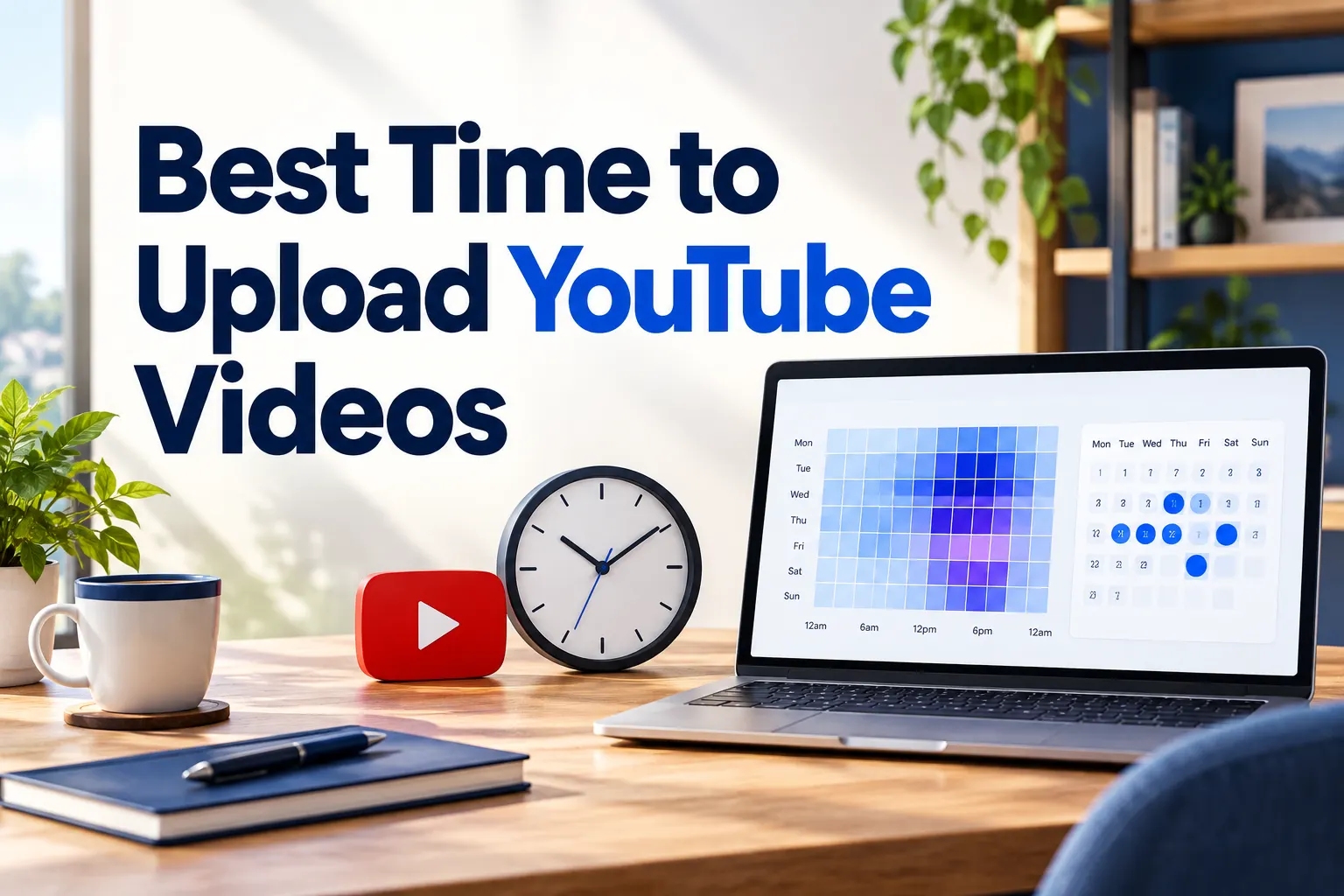
You have finished editing, chosen a thumbnail, and written a title you are excited about. Now comes the question: should you publish the video immediately, wait until the evening, or schedule it for the weekend?
The best time to upload YouTube videos is not the same for every channel. A gaming audience may settle in after school or work, while viewers looking for a software tutorial might watch during the workday. Location, time zones, content type, and viewing habits all influence when your audience is available.
Timing can help your video reach interested viewers when they are ready to watch. It cannot turn an uninteresting topic into a hit or guarantee that YouTube will recommend your content. In this guide, you will learn how to use your own analytics, choose sensible starting times, and test a schedule without getting stuck chasing a mythical perfect hour.
Quick answer: Start with the “When your viewers are on YouTube” report in YouTube Studio. Choose a convenient time near a period of high audience activity, publish consistently, and compare similar videos over several weeks. If you do not have enough data yet, pick a practical audience-friendly window and treat it as an experiment.
Does the Time You Upload a YouTube Video Actually Matter?
It can matter for the first few hours. If more of your regular viewers are online when a video goes public, they may be able to discover and watch it sooner. That can be especially useful for a Premiere, livestream, time-sensitive announcement, or video connected to a live event.
However, an early burst of views is not the same thing as guaranteed long-term growth. YouTube says it has not observed evidence that publish time affects a video’s long-term viewership. Its recommendation system aims to find relevant content for viewers whenever they visit, not just when a video first appears. See YouTube’s explanation of its recommendation system.
A helpful tutorial can continue attracting viewers through search or recommendations long after publication. Likewise, a video published at a busy time can still struggle if its subject, presentation, or packaging does not appeal to viewers.
Think of timing as a distribution decision you can improve, not a shortcut around making a video people want to watch. For a broader approach, see our guide to getting more views on YouTube videos.
How YouTube Distributes Newly Published Videos
When a video is public, viewers may find it through YouTube Search, their subscriptions, the homepage, suggested videos, external links, and other sources. Different surfaces use different signals; there is no single public formula that applies identically to every viewer or video.
YouTube describes recommendations in terms of viewer personalization and content performance. Signals can include a viewer’s watch history and interests, whether people choose to watch a video when it is offered, how much they watch, and indications of satisfaction. Topic interest, competition, and seasonality can also influence reach.
What this means for creators: Publishing near an active period may make it easier for some viewers to watch early, but there is no rule that a video must achieve a particular number of views in its first hour to succeed. Avoid assuming that one slow launch means the video has permanently failed.
Before fine-tuning the clock, make sure the video delivers on its promise. Choose a subject your audience cares about, use a clear title and thumbnail, and make the opening worth watching. Our guide to increasing YouTube watch time explores the viewing experience in more detail.
What Is the Best Time to Post on YouTube?
For an established channel, the best starting point is usually a time when a meaningful share of your intended audience is likely to be available. Your own audience data is more useful than a universal chart because your viewers may live in different places and follow different routines.
If you are starting a new channel and do not yet have a useful audience report, try a reasonable window in your target audience’s time zone:
- Weekday afternoons or early evenings: A practical starting point for audiences who watch after work or school.
- Weekday mornings or lunch breaks: Worth testing for professional, educational, or quick informational content.
- Weekend mornings or afternoons: Possible starting points for leisure, family, hobby, or longer entertainment videos.
These are hypotheses, not platform-wide winners. A channel serving night-shift workers, viewers in several countries, or a community built around live events may see very different patterns.
Illustrative publishing windows by day
The following table is a planning exercise for a channel whose target viewers generally keep daytime work or school hours. Times are in the target audience’s local time. They are not research-backed universal best times.
| Day | Possible window to test | Why test it? |
|---|---|---|
| Monday | 12–2 p.m. or 5–7 p.m. | Test a lunch break against an after-work window. |
| Tuesday | 3–6 p.m. | Try a period that leads into the evening. |
| Wednesday | 12–2 p.m. or 5–7 p.m. | Compare a daytime slot with an evening slot. |
| Thursday | 3–6 p.m. | Test a regular weekday release before evening activity. |
| Friday | 2–5 p.m. | Try a slot before viewers begin weekend plans. |
| Saturday | 9–11 a.m. or 2–5 p.m. | Compare a morning routine with afternoon leisure time. |
| Sunday | 10 a.m.–1 p.m. or 4–7 p.m. | Test a relaxed daytime window against the evening. |
Do not test every window at once. Choose two that fit your audience and production schedule, then collect comparable results.
What Is the Best Day to Upload YouTube Videos?
There is no single best day for every creator. The right choice depends on when your audience has time and on what your video helps them do.
- Work-related tutorials: A weekday may fit viewers searching for an answer while they work.
- Weekend project guides: Publishing before the weekend may give viewers time to discover and plan a project.
- Entertainment and gaming: Evenings or weekends may be worth testing when viewers have longer leisure periods.
- News and product updates: Relevance can matter more than the usual publishing day. A timely video may be worth publishing as soon as it is accurate and ready.
If your analytics show several strong days, choose one you can reliably support. A good day that fits your workflow is more useful than a theoretically ideal day that forces you to rush.
Best Upload Times for Different Audience Types
Start by asking when your viewers have a reason and enough time to watch this particular video. Their needs often reveal better ideas than a generic “best time” list.
Students and younger viewers
Depending on their age, location, and school calendar, students may be more available after classes or on weekends. Exam seasons and holidays can change that routine. If your channel serves students in multiple countries, check which geography actually contributes the most watch time before assuming one school schedule applies to everyone.
Working professionals
Professionals may watch a short industry update before work, search for a tutorial during the day, or save a longer discussion for the evening. A five-minute spreadsheet fix and a 45-minute career interview can serve the same audience at very different moments.
Parents and family audiences
Viewing can depend on family routines, school hours, and whether the content is meant for parents, children, or the whole household. Test a manageable window and pay attention to how holidays or school breaks affect the pattern.
International audiences
A global channel rarely has one perfect time for everyone. Identify your largest or most strategically important audience groups, look for an overlap when possible, and accept that some viewers will discover the video later.
Best Publishing Times by YouTube Niche
A niche is a useful clue, not a substitute for analytics. Use these ideas to form a hypothesis, then check whether your viewers behave that way.
- Gaming: Test after-school, after-work, and weekend windows. For a game update or tournament, the event itself may matter more than your normal slot.
- Education: Test weekday daytime or early evening. A searchable lesson may also gain views steadily as learners need it, rather than only at launch.
- Entertainment: Test evenings or weekends when your viewers may have time to relax. A Premiere can be useful when a community wants to watch together.
- Technology: Tutorials may fit weekday work hours, while reviews and launch coverage may be driven by release dates and audience interest.
- Lifestyle: Consider the routine behind the video. A meal-prep guide might be useful before a viewer plans the week; a morning-routine video may be discovered whenever viewers look for inspiration.
- Fitness: Test around the routines your audience follows, but do not assume everyone exercises before work. Some may watch a workout at a different time from when they plan it.
- News and commentary: Accuracy and timeliness are often more important than waiting for a recurring peak.
For topic ideas that can attract viewers beyond your existing audience, start with our guide to finding the best YouTube keywords. Search demand and viewer intent can help you decide what to publish; your audience report can help you decide when to test publishing it.
How to Find When Your Viewers Are Most Active on YouTube
Your most useful starting point is inside YouTube Studio Analytics. YouTube’s audience analytics documentation explains that the “When your viewers are on YouTube” report shows when your viewers were online across YouTube during the previous 28 days.
Step-by-step: Find the audience activity report
- Sign in to YouTube Studio.
- Select Analytics from the left-hand menu.
- Open the Audience tab.
- Find “When your viewers are on YouTube.”
- Look across the days and hours for the darker blocks, which indicate relatively higher viewer activity. Check the time-zone label shown in your report before choosing a time.
- Note two or three promising windows, then compare them with your own publishing history.
The report reflects when your viewers are on YouTube as a whole, not a promise that they are watching your channel, available for a new upload, or ready to watch a particular format. It includes viewers rather than only subscribers. Your channel’s audience metrics can include viewers of videos, Shorts, and live content, so the overall pattern may not perfectly represent each format separately.
YouTube specifically suggests the report as a way to help plan community activity, Premieres, and livestreams. For ordinary uploads, use it as a starting hypothesis rather than proof of the best publishing time.
Example: Reading the heatmap
Imagine your report shows relatively dark blocks on Thursday from 6–9 p.m. and lighter blocks at 2 p.m. The chart is displayed in your local time zone, and most of your watch time comes from viewers in that same zone.
You might test a Thursday 5 p.m. release against a Thursday 7 p.m. release. The first puts the video out before the busy period; the second falls within it. Neither is automatically better, and YouTube does not require a one- or two-hour lead time for recommendations. Compare similar uploads before choosing a regular slot.
What if the report is missing or has limited data?
New or smaller channels may not have enough data to show every report. Continue publishing at a sustainable pace and use what you know about your intended audience. Review the report again as your channel gathers more viewers; do not treat an empty chart as evidence that nobody is interested.
If you are still building that initial audience, our guide to growing a YouTube channel from zero can help you establish a foundation before you have detailed timing data.
How Location and Time Zones Affect Your Upload Schedule
Your own clock is not necessarily your audience’s clock. In YouTube Studio, review Top geographies in the Audience tab to see where your channel receives watch time. The report may be limited for some channels, and a country can contain several time zones, so treat it as a guide rather than an exact map of every viewer.
When you schedule a video, check both the time-zone label in the audience report and the time zone selected in the scheduling screen. Do not convert a time twice if the heatmap is already displayed in your local zone.
Example: A U.S. creator with viewers in the U.K.
Imagine a creator in Los Angeles wants to reach viewers in both New York and London. On a June date when Los Angeles is on Pacific Daylight Time and London is on British Summer Time:
- 12 p.m. in Los Angeles is 3 p.m. in New York.
- At the same moment, it is 8 p.m. in London.
That could be a reasonable overlap to test. It does not mean noon Los Angeles time is universally optimal: the channel might find that its New York audience contributes more watch time, or that U.K. viewers prefer a different hour. Daylight saving changes can also alter offsets, so check a current time-zone converter for the actual publication date.
If your audiences have little overlap, select the group most relevant to that video or alternate test slots. For evergreen content, remember that people in other time zones can still find and watch the video after it is published.
Best Time to Upload YouTube Shorts vs. Long-Form Videos
Shorts and long-form videos can serve different viewing situations, even on the same channel. A viewer may watch a Short during a brief break but wait until later to watch a detailed tutorial. That makes separate testing worthwhile.
| Consideration | Shorts | Long-form videos |
|---|---|---|
| Starting hypothesis | Test short-break and active-audience windows. | Test windows when viewers may have time for the full topic. |
| Useful comparison | Compare similar Shorts with other Shorts. | Compare similar videos with other long-form uploads. |
| Metrics to review | Views, shown in feed, chose-to-view rate, and viewing duration. | Views, watch time, average view duration, retention, impressions, and click-through rate. |
| Scheduling approach | Choose a frequency you can sustain without sacrificing the opening or idea. | Allow enough preparation for the video, title, thumbnail, and checks. |
For example, a cooking creator might test a quick recipe Short at lunchtime and a detailed weekend meal-prep video on Friday afternoon. The timing choices reflect different viewing intentions; they are not rules about how YouTube ranks either format.
In the Shorts section of Analytics, “shown in feed” indicates how often Shorts appeared in the Shorts Feed, while “how many chose to view” compares viewing with swiping away. YouTube also describes viewer choice, watch duration, and percentage viewed among the signals used to understand Shorts performance. See its Shorts analytics guide and Shorts discovery guidance.
If Shorts are part of your plan, explore our guide to getting more views on YouTube Shorts for ideas beyond timing.
How Far in Advance Should You Upload or Schedule a Video?
Separate three actions that creators often call “uploading”:
- Upload: Send the video file to YouTube and add its details.
- Schedule: Set a future date, time, and time zone for the video to become public.
- Publish: Make the video public immediately or let the scheduled time arrive.
YouTube’s scheduling instructions explain that scheduled publishing makes a private video public at the selected time. Scheduling is a planning tool; it is not a documented ranking advantage.
For a planned video, upload early enough to give yourself a comfortable buffer for processing and any checks, captions, thumbnail review, links, and a final playback. A day ahead can be convenient if your workflow allows it, but it is not a required SEO waiting period. Processing and checks can take different amounts of time, so allow more room for a large file or a high-stakes release.
For timely news, accuracy and relevance may make a shorter turnaround sensible. In either case, check the scheduled date, time, time zone, and visibility before leaving the video to publish.
Why Consistency Matters More Than Chasing a Perfect Hour
A dependable schedule helps you plan production and gives returning viewers a clearer idea of what to expect. More importantly, it protects the time needed to make each video useful.
That does not mean you must publish every day or that missing a Tuesday automatically harms your channel. YouTube recommends a consistent, sustainable schedule and encourages creators to consider production time, content mix, and their own well-being. Its Shorts guidance also says there is no minimum posting cadence required for videos to perform well.
Choose a rhythm you can maintain: one thoughtful video every two weeks may be a better fit than three rushed videos each week. Use scheduling and batch preparation where practical, while leaving room for timely stories or an occasional break.
Before a video goes live, give its packaging the same attention as its release time. Use the YouTube title generator to brainstorm options, then edit the result so it accurately reflects your video. The YouTube description generator can help you prepare a useful description; review any generated text and links before publishing.
How to Test Different YouTube Publishing Times
A good timing test is simple enough to repeat and careful enough to avoid drawing conclusions from one unusually successful video.
1. Pick one question
For example: “Do my Thursday videos get a better initial response at 5 p.m. or 7 p.m.?” Keep the day the same so you are not changing the day and hour at once.
2. Choose comparable uploads
Compare videos with similar formats, subjects, lengths, and intended audiences where possible. You cannot make two different videos identical, so record major differences such as a trend, collaboration, paid promotion, or holiday.
3. Alternate the slots
Publish at 5 p.m. one week and 7 p.m. the next, then repeat. Aim for several uploads in each slot—for example, four per slot over eight weeks if you publish weekly. This is a practical starting sample, not a statistically guaranteed test. If you publish less often, run the test longer or accept that the evidence will be limited.
4. Compare equal time windows
Record each video’s results at the same age: for example, after 24 hours and again after seven days. For long-form videos, review views and watch time alongside impressions, click-through rate, and audience retention. Interpret click-through rate in context: traffic sources and the number of impressions can differ substantially between videos.
For Shorts, compare views alongside shown in feed, chose-to-view rate, and viewing duration. Do not compare a Short’s raw numbers directly with a long-form video and assume the difference is caused by timing.
5. Look for a pattern, not a single winner
Use the median—the middle result after sorting the videos in each group—or inspect the full range. An outlier can distort an average. If the results are close or inconsistent, choose the slot that is easier to sustain and continue observing.
Illustrative result: Suppose four comparable 5 p.m. videos receive 300, 340, 380, and 420 views in their first 24 hours. Their median is 360. Four 7 p.m. videos receive 360, 400, 440, and 480 views, giving a median of 420. The 7 p.m. slot is worth continuing to test, but the difference does not prove that timing caused the improvement. Topics, thumbnails, audience interest, and other factors may have changed.
Example: Adjusting a schedule using analytics
Imagine a technology channel originally publishes tutorials every Thursday at noon. Its audience report shows stronger activity in the evening. After alternating noon and 6 p.m. for several comparable uploads, the creator sees higher typical 24-hour views at 6 p.m., while seven-day results are similar.
The creator decides to keep 6 p.m. because early discussion is useful and the slot fits the production workflow. They do not claim that evenings improve long-term reach. A month later, they review the audience report again in case viewer habits have shifted.
A Practical Weekly YouTube Upload Schedule
Here is an example for a creator who can sustainably produce one long-form video and two Shorts per week. The times are illustrative and should be adapted to the audience’s time zone and your own results.
| Day | Action | Purpose |
|---|---|---|
| Monday | Review last week’s analytics and choose the next topic. | Identify useful patterns without reacting to one day of data. |
| Tuesday | Publish a Short at a test time, such as 12 p.m. | Test a brief-viewing window with a self-contained idea. |
| Wednesday | Finish the long-form edit, thumbnail, description, and checks. | Leave a buffer before publication. |
| Thursday | Publish the long-form video at a test time, such as 5 p.m. | Give viewers a predictable weekly release. |
| Friday | Review initial comments and early performance. | Answer useful questions and note observations. |
| Saturday | Publish a second Short at a test time, such as 10 a.m. | Try a different day and audience routine. |
| Sunday | Plan or batch-produce upcoming content—or take a break. | Keep the schedule sustainable. |
This is a production plan, not a requirement to post three times a week. If one video every other week is realistic, build your schedule around that instead. Also, test Shorts and long-form slots separately; Tuesday versus Saturday changes both the day and the time, so that comparison alone cannot identify which factor mattered.
Common Mistakes When Choosing an Upload Time
- Copying another channel’s schedule: Their audience, location, and content may be very different from yours.
- Ignoring time zones: A convenient hour for you may be the middle of the night for most of your audience.
- Treating the heatmap as a prediction: It shows past activity across YouTube, not who will click your next video.
- Changing everything at once: If the topic, thumbnail, format, day, and hour all change, you cannot reasonably attribute the result to timing.
- Judging one upload: An unusually strong topic or a weak thumbnail can outweigh a small timing difference.
- Focusing only on the first hour: Review longer windows too, especially for searchable or evergreen videos.
- Confusing an association with a cause: Videos posted at a certain hour may perform well for reasons unrelated to the clock.
- Rushing to hit a slot: A polished, accurate video is generally a better use of your attention than publishing an unfinished one on time.
- Checking analytics without context: Holidays, trends, traffic sources, and audience changes can all affect comparisons.
A strong thumbnail can make the video’s value easier to understand when it appears to a viewer. Before launch, review our YouTube thumbnail size guide and make sure the image remains clear on a small screen.
Your Step-by-Step YouTube Upload Schedule Checklist
Use this checklist the next time you plan a release:
- Define the viewer and purpose. Is the video for existing fans, people searching for a solution, or viewers responding to a current event?
- Check audience location. Identify the most relevant geographies and note their time zones.
- Review audience activity. Find promising periods in “When your viewers are on YouTube,” if the report is available.
- Choose one or two test slots. Use the report and viewer context to form a hypothesis, not a guarantee.
- Prepare the video early. Leave time for processing, checks, captions, thumbnail, title, description, and playback.
- Schedule carefully. Confirm the date, time, time zone, and visibility in YouTube Studio.
- Compare similar content at equal ages. Check a consistent early window and a longer window, such as 24 hours and seven days.
- Record context. Note unusual topics, promotions, holidays, or collaborations that could affect the result.
- Keep or adjust the schedule. Favor a repeatable pattern over a one-off spike, and revisit it as your audience changes.
Frequently Asked Questions
1. What is the best time to upload YouTube videos?
There is no universal best time. Start with the periods when your viewers are active in YouTube Studio, then test times that fit your audience and workflow. For a new channel, choose a reasonable window in your target audience’s time zone and refine it as data becomes available.
2. What is the best day to post on YouTube?
The best day depends on your viewers and the video. A work tutorial, a weekend project guide, and a breaking-news update can each have different ideal circumstances. Look for a day your audience uses YouTube and that you can support consistently.
3. Is it better to publish YouTube videos in the morning or evening?
Either can work. Morning may suit viewers looking for information before or during their day; evening may suit viewers with more leisure time. Compare similar videos in both windows rather than assuming one is better.
4. Does upload time affect YouTube views?
It may affect how quickly some viewers see a new video, especially when your audience is online. YouTube says publish time is not known to affect long-term performance. Content relevance, presentation, viewer interest, and satisfaction remain important.
5. How can I find the best time to upload for my audience?
Open YouTube Studio, select Analytics, and visit the Audience tab. Use the “When your viewers are on YouTube” report to identify candidate windows, check the displayed time zone, and test those windows with comparable uploads.
6. What is the best time to upload YouTube Shorts?
There is no single best time for Shorts. Start with your audience’s active periods or likely short breaks, then compare similar Shorts using views, shown in feed, chose-to-view rate, and viewing duration. A good Shorts slot may differ from your long-form slot.
7. How often should I upload videos on YouTube?
Publish as often as you can maintain quality and a sustainable workflow. The right frequency could be several times a week or a few times a month. There is no required minimum Shorts posting cadence for a video to perform well.
8. Should I upload when my subscribers are online?
It can be a useful starting point, particularly if you want early interaction. However, the audience activity report is about your viewers’ activity across YouTube, not just subscribers, and being online does not mean someone will watch your video immediately.
9. Does scheduling YouTube videos affect views?
Scheduling makes a private video public at a chosen time. It helps with planning and consistency, but there is no reason to treat scheduling itself as a guaranteed boost or penalty. Review the scheduled settings before publication.
10. What happens if I publish a YouTube video at night?
It becomes available to viewers who are awake and can still be discovered later by everyone else. Night may be appropriate if your audience is in another time zone or follows an evening routine. Compare your actual results before deciding it is a poor choice.
Final Thoughts
The best posting time for YouTube is the one that fits your audience, your content, and a schedule you can realistically maintain. Start with YouTube Studio’s audience activity report, account for geography and time zones, and test a small number of sensible publishing windows.
Keep timing in perspective. A useful idea, a clear title and thumbnail, and a satisfying video give viewers a reason to choose and continue watching. Publishing at a convenient time can support that work—but it cannot replace it.

Ahassan
CEO / Co-Founder
Hello, I'm A Hassan, the owner of YTLargeTools. I created YTLargeTools with a simple goal: to make useful online tools accessible to everyone. I believe everyday tasks should be simple, convenient and easy to complete without unnecessary complications.
Recent Posts