How to Increase YouTube Watch Time?
How to increase YouTube watch time with better video openings, retention analytics, playlists, and practical tips for earning eligible watch hours.
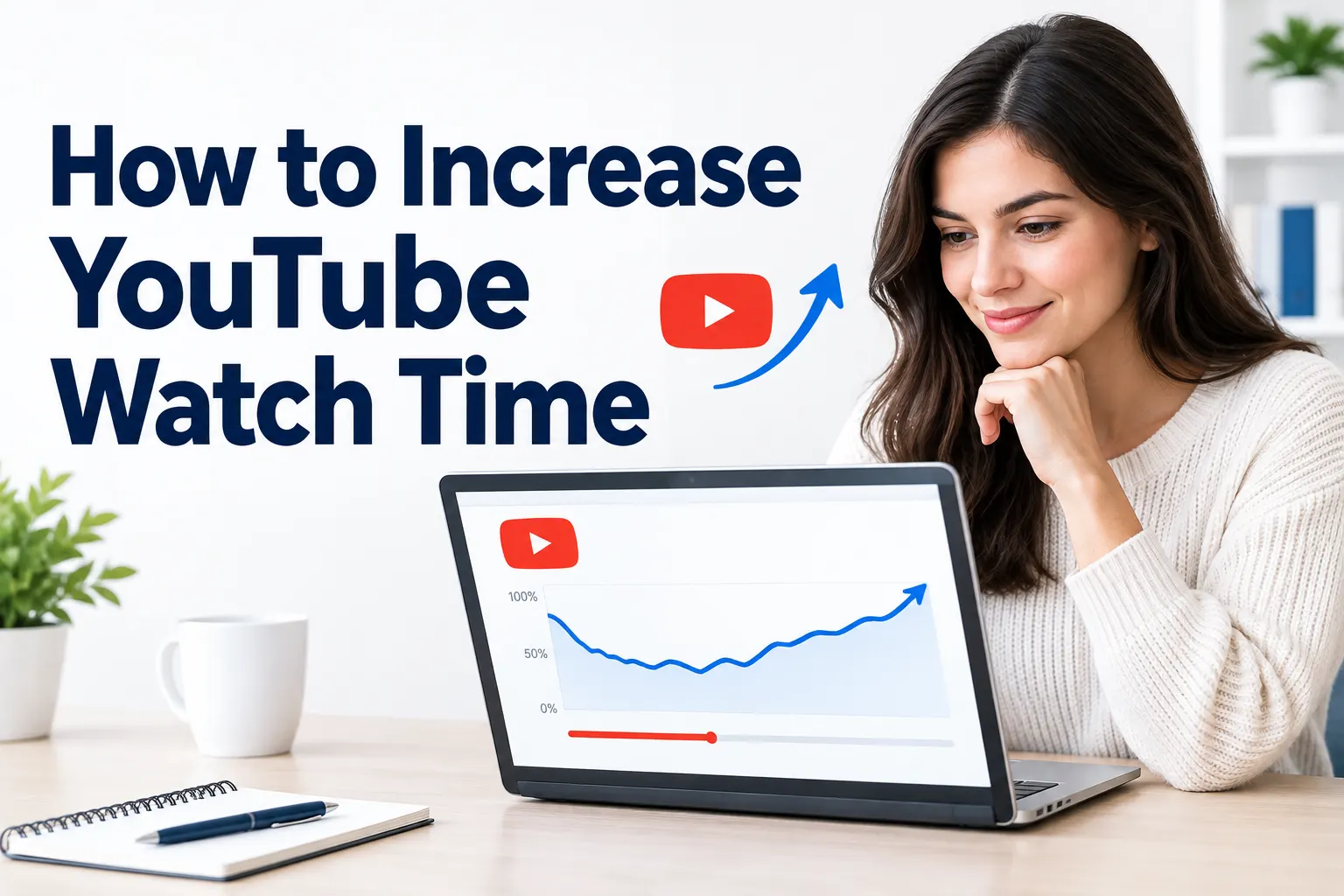
Getting someone to click your video is only the beginning. The harder-and more valuable-challenge is giving them a reason to stay.
If you want to learn how to increase YouTube watch time, start by looking beyond tricks and editing effects. The most reliable improvements come from choosing a topic your audience cares about, making a clear promise, and delivering on it without wasting the viewer’s time.
This guide explains how watch time works, how to read your retention reports, and how to turn those insights into better videos. You’ll also learn which watch hours count toward YouTube Partner Program eligibility and which ones do not.
What Is YouTube Watch Time, and Why Does It Matter?
Watch time is the total amount of time viewers spend watching your content. YouTube reports it in hours in YouTube Analytics.
It matters because watch time helps you understand whether your videos are attracting attention and holding it. A video can get plenty of clicks but disappoint viewers quickly. Another may reach fewer people yet keep them engaged for much longer. Both pieces of information can help you decide what to improve next.
Watch time is also one of many signals YouTube may use when recommending content. But it is not a shortcut to guaranteed distribution. Recommendations are personalized, and YouTube considers multiple signals of viewer interest and satisfaction. A longer video does not automatically outperform a shorter, more useful one.
Think of watch time as a result of serving the right viewer well-not as a number to inflate at any cost.
How Does YouTube Calculate Watch Time?
At a basic level, watch time is the sum of the time viewers spend watching a video during a selected period.
Example: If 1,000 views produce an average of four minutes watched per view, the video generates approximately 4,000 minutes of watch time. Divide by 60, and that is about 66.7 hours.
This is a useful estimate, not a promise about eligibility. Your Analytics watch time and the public watch hours shown in the Earn section can differ because YouTube applies specific rules when calculating Partner Program eligibility.
Watch time vs. average view duration vs. audience retention
| Metric | What it tells you | How to use it |
|---|---|---|
| Watch time | The total time viewers spent watching. | Understand the overall viewing time your content generates. |
| Average view duration | The average amount of time watched per view for the selected content and reporting period. | Compare how long viewers typically stay with similar videos. |
| Audience retention | How viewing holds up across the video, including where people leave, skip, or rewatch. | Find specific moments to investigate and improve. |
For example, a 10-minute video with a five-minute average view duration has an average percentage viewed of about 50%. That does not mean every viewer leaves at the five-minute mark. Some may watch the whole video, while others leave much earlier or replay a section.
Important: YouTube calculates some Shorts metrics differently. For Shorts, average view duration is based on engaged views and their corresponding watch time, so avoid comparing it directly with a long-form video without considering the format.
Start With the Right Topic and Viewer Expectation
Retention problems often begin before recording. If a video promises one thing but delivers another, even excellent editing may not keep viewers watching.
Before you write a script, answer three questions:
- Who is this for? A first-time creator and an experienced editor may need different explanations.
- What does the viewer want to do or understand? Make the outcome specific.
- What can the video deliver? Choose a promise you can fulfill with the information, examples, and time available.
Suppose you plan a video about YouTube thumbnails. “Everything about thumbnails” is broad. “How to make a readable thumbnail on your phone” gives a particular viewer a clear reason to watch.
Use the guide to finding YouTube keywords to explore how people describe their questions. Then check whether your video actually answers the question behind the phrase.
Make titles and thumbnails accurate, not just clickable
Your title and thumbnail set the expectation that the opening must meet. If your thumbnail says “Edit Faster” but the first two minutes discuss camera equipment, the wrong viewers may leave-even if the equipment advice is good.
Choose one clear idea for the thumbnail and use the title to add context. For example:
- Vague: “My Best YouTube Tips!”
- Clearer: “How to Edit a YouTube Video Faster: 5 Practical Changes”
A YouTube title generator can help you brainstorm angles, but review every suggestion for accuracy and make sure the video delivers what it promises. For the visual side, see the YouTube thumbnail size guide.
How to Keep Viewers Watching YouTube Videos
1. Make the first moments earn attention
Viewers need quick confirmation that they clicked the right video. Open with the problem, the result, or a relevant demonstration. You can introduce yourself after the viewer understands what they will gain.
Weak introduction:
“Hey everyone, welcome back to my channel. I hope you’re all having a great week. Before we start, please like and subscribe. Today I wanted to talk about a few things I’ve learned about video editing.”
More engaging introduction:
“If editing a 10-minute video takes you all afternoon, start with these three changes. I’ll show you the first one on a real timeline-and where it saves the most time.”
The second opening identifies the audience, offers a useful outcome, and previews a concrete demonstration. It does not need a dramatic claim or a loud sound effect.
Try this: Record your introduction last. After you finish the video, you will know exactly what it delivers and can make a more accurate promise.
2. Use storytelling to give information a reason to unfold
Storytelling is not limited to documentaries or personal vlogs. A tutorial can use a simple progression: problem, attempt, obstacle, solution, result.
For example, instead of listing three lighting tips, show a poorly lit shot and explain the challenge: “The window is behind me, so my face looks dark.” Move the camera, show the result, then explain the adjustment. The viewer sees the problem and understands why the solution matters.
Another useful technique is a small, honest question that the video answers later: “Which microphone sounds clearer in a noisy room?” Play the comparison before explaining the result. Do not withhold essential information for longer than necessary just to create suspense.
3. Structure videos around the viewer’s next question
A clear structure reduces the effort required to follow your video. Each section should answer a question that naturally follows the previous one.
Here is a sample structure for an eight-minute beginner tutorial. The timings are examples, not a formula:
- 0:00–0:20 - Promise and preview: Show the finished result and explain who the tutorial helps.
- 0:20–1:00 - Essential setup: Cover only what viewers need before starting.
- 1:00–3:00 - First action: Demonstrate the most important step on screen.
- 3:00–5:30 - Build on it: Complete the remaining steps and explain common mistakes as they appear.
- 5:30–7:15 - Test the result: Show what success looks like and troubleshoot one likely problem.
- 7:15–8:00 - Next step: Summarize the outcome briefly and point to a genuinely relevant follow-up video.
If your topic needs four minutes, do not stretch it to eight. If it needs 20, do not cut an important explanation just to hit a shorter runtime.
4. Improve pacing by removing friction
Good pacing means the video moves at a speed appropriate for the audience. A beginner may need a slower demonstration; an experienced viewer may prefer the result first and a concise explanation afterward.
During editing, look for:
- Repeated explanations that add no new information.
- Long file-loading sequences or screen recordings with no useful action.
- Extended greetings, unrelated personal updates, or multiple requests to subscribe before the lesson starts.
- Pauses where you search for a menu, restart a sentence, or repeat an instruction.
- A long conclusion after the promised answer has already been delivered.
Cut or shorten those moments, but keep pauses that allow viewers to absorb a difficult idea. A helpful test is to ask: “What does this moment help the viewer understand, feel, or do?” If the answer is unclear, reconsider it.
5. Use visual changes when they clarify the story
A pattern interruption is a change that refreshes attention-for example, switching from a presenter to a screen demonstration. It works best when it supports the explanation rather than interrupting it.
Try a close-up when pointing out a small setting, a simple on-screen label when introducing a new term, or a before-and-after comparison when showing a result. Captions and clear audio also make the video easier to follow.
You do not need a new zoom, sound effect, or transition every few seconds. Too many changes can make the video harder to follow and may distract from the lesson.
Use YouTube Audience Retention Reports to Find the Real Problem
Retention data helps you move from “I think this part is boring” to “Viewers often skip or leave around this specific moment.” It is a starting point for investigation, not a perfect explanation of what viewers were thinking.
How to check your retention report
- Open YouTube Studio and select Content.
- Choose a video, then open Analytics.
- In the Overview or Engagement tab, find the audience retention report.
- Play the video alongside the graph and note the timestamps of major dips, spikes, and strong sections.
- Where available, compare viewer segments and videos of similar length. Give the report time to process; YouTube says retention data typically takes one to two days.
The intro measure shows the percentage of viewers still watching after the first 30 seconds. A steep early decline may point to a slow opening or a mismatch between the packaging and the content. It may also reflect the audience or traffic source, so review the context before drawing a conclusion.
According to YouTube’s audience retention guidance, a dip can mean viewers skipped a section or stopped watching. A spike can indicate rewatching or sharing, but it can also mean a section was confusing enough to replay. Watch the moment yourself before deciding whether to repeat it or clarify it.
A practical drop-off diagnosis
Imagine a tutorial drops sharply at 0:45. At that point, the creator pauses the lesson for a long explanation of their equipment.
- Observation: The drop begins when the equipment discussion starts.
- Possible explanation: Viewers came for the tutorial and did not need the equipment details yet.
- Next test: In a comparable future tutorial, begin the demonstration sooner and move essential equipment details into a short on-screen note.
- What to compare: Look at the first 30 seconds, the relevant section, average view duration, and traffic sources-not just one percentage.
Do not assume every dip means a section is bad. Viewers may skip material they already know. Likewise, a spike is not automatically a highlight. The graph tells you where to look; the video and audience context help explain why.
Build Playlists That Encourage a Useful Next View
A playlist can make it easier for a viewer to continue learning, especially when each video solves the next logical problem. The benefit comes from relevance and convenience-not from putting every upload in one enormous list.
For example, a beginner creator playlist might follow this order:
- Choose a channel topic.
- Plan your first video.
- Record clear audio with a phone.
- Edit the first video.
- Publish it with an accurate title and thumbnail.
Give the playlist a descriptive name, arrange the videos in a sensible order, and remove outdated or unrelated entries. Mention the playlist when a viewer is likely to need the next step-not before you have delivered the current one.
If your audience is still setting up its first channel, the beginner’s guide to growing a YouTube channel provides a useful starting point.
Use End Screens and Cards With a Clear Purpose
An end screen works best when the next video feels like a continuation, not an unrelated promotion. For a tutorial about recording audio, a useful follow-up might show how to remove background noise.
Near the end, explain the connection: “Now that your audio is recorded, the next video shows how to clean up the background noise.” Leave enough visual space for the end-screen element while you say it.
YouTube allows end screens in the last 5–20 seconds of eligible videos; the video must be at least 25 seconds long. Availability varies, including for content set as made for kids. Review YouTube’s end-screen requirements before planning around them.
Cards can point viewers to relevant content during a video where the feature is available. Use them when an optional resource helps-for example, a separate beginner setup guide-rather than interrupting the main explanation with several competing choices. Check your analytics to see whether viewers use the links.
Shorts vs. Long-Form Videos: How Watch Time Differs
Shorts and long-form videos can both help people discover your channel, but their metrics and monetization paths are not interchangeable.
- Long-form videos: Review watch time, average view duration, and the retention graph together. For monetization eligibility, only qualifying public watch hours count toward the applicable watch-hour threshold.
- Shorts: Look at watch time alongside metrics such as engaged views and how often viewers choose to continue watching rather than swipe away. Replays can also affect viewing behavior.
- Shorts views: A public Shorts view count can include starts and replays. YouTube uses qualified engaged Shorts views for the relevant YPP eligibility path, so the public view count is not necessarily the eligibility count.
Most importantly, watch time from Shorts views in the Shorts Feed does not count toward the 4,000 public watch-hour threshold. Shorts have a separate qualified views path. See YouTube’s explanation of Shorts views for the current definitions.
Use Shorts as a complementary format: share one useful idea, then make a related long-form video for viewers who want the full explanation. That connection should be valuable on its own, not a promise that every Shorts viewer will become a long-form viewer. For format-specific ideas, read how to get more views on YouTube Shorts.
How to Get More Watch Hours on YouTube for Monetization
If your goal is the YouTube Partner Program, distinguish total watch time in Analytics from valid or qualified public watch hours in the Earn section. The latter is an eligibility measure with specific rules and a rolling time window.
YouTube watch hours requirements: the main paths
For the higher YPP eligibility threshold associated with ad and YouTube Premium revenue sharing, YouTube lists either:
- 1,000 subscribers and 4,000 qualified public watch hours in the past 12 months; or
- 1,000 subscribers and 10 million qualified public Shorts views in the past 90 days.
In eligible countries and regions, YouTube also offers an earlier-access YPP tier for certain fan-funding and Shopping features. Its listed thresholds are 500 subscribers, three valid public uploads in the past 90 days, and either 3,000 qualified public watch hours in the past 12 months or 3 million qualified public Shorts views in the past 90 days. This earlier tier is not the same as qualifying for ad revenue sharing.
Meeting a threshold does not guarantee acceptance. YouTube reviews the channel and requires creators to meet other conditions, including applicable monetization policies. Availability and individual feature requirements can vary. Check YouTube’s YPP eligibility guidance, its expanded YPP guidance, and your own YouTube Studio → Earn page for the latest requirements.
Which watch hours count toward the 4,000-hour threshold?
YouTube describes qualified watch hours as those gained from public long-form videos. Its published exclusions include watch hours from:
- Private, unlisted, or deleted videos.
- Ad campaigns.
- Shorts, including watch time from Shorts views in the Shorts Feed.
- Livestreams that are unlisted, deleted, or not converted to video on demand.
A public livestream that remains available as a public replay can be useful, but do not assume every live-stream hour will qualify. Check the Earn page and YouTube’s current rules, especially before changing a video’s visibility or deleting it.
Practical ways to build eligible public watch hours
- Publish helpful public long-form videos. Choose topics that warrant a full explanation and deliver the promised answer.
- Make connected videos. Build a small series around a viewer’s progression rather than publishing unrelated topics.
- Improve existing discovery opportunities. Update inaccurate titles or thumbnails and connect relevant videos with playlists and end screens.
- Consider useful public livestreams. A focused question-and-answer session or demonstration can serve viewers live and as a replay. Keep eligibility rules in mind.
- Review the Earn tab regularly. It is the place to check your channel’s progress toward the applicable thresholds.
For perspective, 4,000 hours equals 240,000 minutes. At an average of five qualifying minutes per view, that would be roughly 48,000 qualifying views. This is only an illustration: actual viewing times vary, not every view qualifies, and the hours must fall within the rolling 12-month window.
Do not buy watch hours, use bots, or participate in artificial engagement schemes. They do not build an interested audience and can violate YouTube’s policies.
Step-by-Step Example: Improve an Underperforming Video
Suppose you published a 12-minute video called “How to Organize Your Video Editing Files.” After the initial data has had time to process, you notice that many viewers leave early and that a later demonstration holds attention well.
- Check the promise. The title suggests a file-organization tutorial, but the video begins with two minutes about your computer. That mismatch is a plausible reason to investigate the early drop.
- Watch the key moments. The retention graph shows a dip during the equipment discussion and a stronger section when the folder structure appears on screen. A dip alone does not prove the cause, but it gives you a useful hypothesis.
- Improve what you can on the published video. Make the title and thumbnail accurately reflect the lesson. Add the video to a relevant playlist and connect it to a useful next video with an end screen. If an eligible trim would help, review YouTube Studio’s editor and its current save and undo limitations before making changes.
- Apply the lesson to the next video. Open with the finished folder structure, explain the benefit in one sentence, and begin the demonstration. Keep equipment details only where they affect the steps.
- Compare thoughtfully. After the new video has enough data, compare the introduction, average view duration, and traffic sources with similar videos. Different topics and audiences can affect results, so treat the comparison as a learning exercise rather than proof of a single cause.
The key insight: not every fix requires replacing a published video. Some improvements are packaging or navigation changes; others belong in your next script and edit.
Common Mistakes That Reduce YouTube Watch Time
- Promising more than the video delivers: A misleading title may earn clicks from viewers who are unlikely to stay.
- Delaying the useful part: Long introductions and unnecessary background can make viewers leave before the lesson begins.
- Adding length without adding value: Extra minutes only help if viewers have a reason to watch them.
- Overediting: Constant cuts and effects can make a straightforward explanation exhausting.
- Ignoring audio and clarity: Viewers should not have to struggle to hear or understand the main point.
- Comparing unlike videos: A 30-second Short and a 20-minute tutorial serve different purposes and need different benchmarks.
- Chasing a single metric: Retention, views, audience needs, and traffic sources all provide context.
- Using artificial engagement: Purchased views or watch hours are not a sustainable growth strategy.
A Simple YouTube Watch Time Improvement Checklist
Use this checklist before and after your next upload:
- Identify one specific viewer and the question the video answers.
- Make sure the title and thumbnail match the actual content.
- Show or explain the promised outcome early.
- Put the most useful material where viewers can reach it without unnecessary delay.
- Remove repeated explanations and irrelevant pauses.
- Use visuals to clarify important steps, not to fill silence.
- Connect the video to one relevant follow-up or playlist.
- Review the retention graph after data is available.
- Write down one hypothesis and one change to test in a future video.
- Check the Earn section separately if you are tracking YPP eligibility.
Repeat this process across several comparable uploads. A single video may not tell you much, but a pattern can reveal which topics, openings, or explanations work better for your audience.
Frequently Asked Questions
1. What is a good watch time for a YouTube video?
There is no universal number. A useful benchmark depends on video length, topic, audience, and traffic source. Compare similar videos on your own channel, then look at whether viewers reach the parts that deliver the promised value.
2. How can I increase YouTube watch hours quickly?
Start with videos already attracting the right viewers: improve inaccurate packaging, connect relevant videos, and use retention data to make your next upload more focused. Results vary, and there is no legitimate guaranteed shortcut.
3. How does YouTube calculate watch time?
YouTube adds the time viewers spend watching your content and reports it in Analytics. The public watch hours used for YPP eligibility are a separate, filtered measure, so the two totals may not match.
4. Do YouTube Shorts count toward 4,000 public watch hours?
No. Watch time from Shorts views in the Shorts Feed does not count toward the 4,000-hour threshold. YouTube offers a separate YPP eligibility path based on qualified public Shorts views.
5. How can I get 4,000 watch hours on YouTube?
Build a library of useful public long-form videos, help viewers find relevant follow-ups, and improve future videos using retention reports. The threshold covers qualifying hours from the past 12 months, not all-time watch time.
6. Why are my YouTube watch hours decreasing?
The YPP counter uses a rolling 12-month period, so older hours eventually fall outside it. Changes to video visibility or deletion can also affect eligibility. Analytics totals can move for other reasons, including the date range selected.
7. Does average view duration affect YouTube recommendations?
Viewing behavior can be one signal among many, but a specific average view duration does not guarantee recommendations. Focus on satisfying the viewers who choose the video rather than optimizing one number in isolation.
8. How can beginners increase watch time?
Choose a narrow question, answer it early, use clear audio, and make the next step easy to follow. After publishing, review where viewers leave and use one insight to improve the next video.
9. Do playlists help increase YouTube watch time?
They can help viewers find and watch related videos in a useful order, but they do not guarantee more viewing. A focused playlist with a clear progression is more helpful than a collection of unrelated uploads.
10. Where can I check YouTube watch time?
Open YouTube Studio → Analytics to review watch time and related performance metrics. Open YouTube Studio → Earn to check your progress toward the monetization requirements shown for your channel.
Final Thoughts
Increasing YouTube watch time is not about keeping people in a video for as long as possible. It is about making each minute worth watching.
Start with an honest title and thumbnail, deliver the promised value early, and use your retention report to find the moments where viewers need a clearer or more engaging experience. Then connect your best videos in a way that helps viewers take the next step.
For more ideas on reaching the right audience, explore how to get more views on YouTube videos. Better discovery and a better viewing experience work best together.
Ahassan
CEO / Co-Founder
Hello, I'm A Hassan, the owner of YTLargeTools. I created YTLargeTools with a simple goal: to make useful online tools accessible to everyone. I believe everyday tasks should be simple, convenient and easy to complete without unnecessary complications.
Recent Posts