How Much Does YouTube Pay for 1,000 Views?
Find out how much YouTube pays for 1,000 views in 2027. Learn about RPM, CPM, Shorts earnings, country differences, and factors that affect creator revenue.
How Much Does YouTube Pay for 1,000 Views?
YouTube does not pay a fixed amount for every 1,000 views. A monetized creator’s earnings depend on factors such as where viewers live, what the video is about, whether ads are shown, and whether the views come from Shorts or long-form videos.
The most useful starting point is RPM, or revenue per mille: the revenue a creator earns per 1,000 views after YouTube’s revenue share. RPM can include several YouTube revenue sources, not just advertising. For Shorts, YouTube uses engaged views when calculating RPM.
Illustrative example: If a long-form video has an RPM of $3, then 1,000 views would correspond to approximately $3 in revenue included in that RPM. That $3 is a hypothetical figure-not an official YouTube average or a guaranteed payment. A video that is not eligible for monetization may earn no advertising revenue for its creator, even if it receives thousands of views.
The difference between an estimate and an actual payment matters. Your own YouTube Studio data is a better guide than a generic rate, although even Studio’s estimated revenue can change before it is finalized.
How Does YouTube Calculate Earnings Per 1,000 Views?
YouTube reports several related metrics, but they do not all measure the same thing. Understanding the distinction makes earnings estimates much more useful.
- CPM: Cost per mille is what advertisers pay per 1,000 ad impressions, before YouTube’s revenue share. One video playback can show more than one ad.
- Playback-based CPM: The advertiser cost per 1,000 video playbacks on which at least one ad was shown. It is different from CPM per ad impression.
- Monetized playbacks: Video playbacks in which a viewer was shown at least one ad. They are not the same as all views.
- Total video views: The views counted for the video, including views that did not show an ad.
- RPM: The creator-focused revenue metric per 1,000 views, after YouTube’s share. It can include ads, YouTube Premium, memberships, Super Chat, and Super Stickers.
YouTube explains these distinctions in its guide to ad revenue analytics. CPM is not your take-home rate: it describes advertiser spending, while RPM uses a different denominator and reflects creator revenue after YouTube’s share. RPM also does not account for expenses or taxes.
For eligible Watch Page advertising on long-form videos, YouTube says the creator share is 55% of applicable net ad revenue. That does not mean you can reliably calculate RPM by multiplying CPM by 55%: ad impressions, monetized playbacks, and total views are different counts. Other revenue sources can affect RPM, too. YouTube’s Partner Program overview explains the different revenue-sharing models.
YouTube Earnings Calculator: Estimate Your Potential Revenue
For a long-form estimate, start with your own RPM for comparable videos and the same kind of time period:
Estimated revenue = (Total views ÷ 1,000) × RPM
The table below uses a hypothetical long-form RPM of $3. It is an illustration, not a YouTube benchmark.
| Video views | Calculation at a hypothetical $3 RPM | Illustrative revenue |
|---|---|---|
| 1,000 | 1 × $3 | $3 |
| 10,000 | 10 × $3 | $30 |
| 100,000 | 100 × $3 | $300 |
| 500,000 | 500 × $3 | $1,500 |
| 1 million | 1,000 × $3 | $3,000 |
These figures assume the same RPM at every view count. In practice, the audience, season, ad demand, and mix of revenue sources can change as a video reaches more people. An established channel can test a low, middle, and high scenario based on its own historical data; a new channel should treat any assumed rate as especially uncertain.
You can also explore scenarios with the YouTube Money Calculator. Check the tool’s input labels and method: its page describes estimates using views and CPM. An advertiser CPM is not interchangeable with creator RPM, so do not treat a CPM-based result as a confirmed payout.
For Shorts, use the relevant Shorts RPM and engaged-view figures in Analytics rather than applying a long-form RPM to the public view count.
How Much Does YouTube Pay for 1,000 Views in Different Countries?
Advertisers compete for particular audiences, not just for a creator’s home address. A channel based in Pakistan whose viewers mostly live in the United States may have a different advertising profile from one whose viewers mostly live in Pakistan. A mixed international audience produces a blended result.
The United States, United Kingdom, Canada, and Australia are examples of markets where some advertisers may be willing to spend more to reach potential customers. India and Pakistan have large audiences, but advertising demand, purchasing power, competition, and campaign budgets can differ from those in other markets.
None of this establishes a fixed country rate or a reliable ranking for every channel. An English-language business tutorial watched in India and a local entertainment video watched in the United States can attract very different advertisers. Topic, viewer intent, format, and the ads available at that moment all matter.
To make the comparison useful, look at the geography reports available in YouTube Studio over a meaningful period. Compare similar videos and note changes in audience mix before attributing an RPM increase or decrease to one country.
How Much Does YouTube Pay for 1,000 Views in Different Niches?
A niche can influence earnings because advertisers value different audiences and purchases differently. A viewer researching business software may be closer to a buying decision than someone watching a general comedy clip. Still, a niche label alone tells you very little about a specific video.
- Finance and investing: Financial services may compete for relevant audiences, but content quality, suitability, and viewer location still matter.
- Technology: Software tutorials, product comparisons, and device reviews can attract different advertisers and levels of purchase intent.
- Business and marketing: Topics such as workplace tools or business services may appeal to advertisers seeking professional customers.
- Education: A career-skills tutorial and a broad classroom lesson may reach very different audiences and advertisers.
- Gaming and entertainment: Individual games, formats, audience demographics, and advertiser suitability can change the outcome considerably.
- Lifestyle and cooking: These categories can cover anything from everyday routines to product-focused tutorials, so there is no single rate for either.
These are broad examples, not guaranteed earnings rankings. A well-monetized gaming channel can outperform a finance channel, and a high RPM is not necessarily the same as higher total income: views, production costs, and other revenue sources matter too.
How Much Does YouTube Pay for 1,000 Shorts Views?
There is no fixed payment for 1,000 Shorts views, and a long-form RPM is not a reliable shortcut. Shorts Feed advertising uses a pooled system rather than simply assigning the ads shown next to an individual Short to that creator.
According to YouTube’s Shorts monetization policy, revenue from ads between Shorts is pooled each month. YouTube calculates a Creator Pool, including adjustments associated with music licensing, then allocates it to eligible creators based on their share of eligible engaged views in each country. Creators receive 45% of their allocated Creator Pool revenue.
Music affects how the overall pool is calculated; YouTube says using music does not reduce an individual creator’s allocation or their 45% share. Eligibility still matters: non-original content, artificial views, and content that fails advertiser-friendly requirements can produce ineligible views.
Public Shorts views are not interchangeable with eligible engaged views. For payment calculations, YouTube uses eligible engaged views. Shorts RPM is also based on engaged views, so use matching metrics and the same date range when estimating. A creator must be an eligible monetizing partner and accept the Shorts Monetization Module; views before acceptance do not earn Shorts Feed ad revenue retroactively.
What Factors Affect YouTube Earnings Per 1,000 Views?
RPM is the result of several moving parts. Their importance varies by channel, and a change in one factor does not always cause an obvious change in revenue.
- Viewer location: The countries where people watch can affect the available advertisers and their bids.
- Niche and demand: Advertisers may compete more for some topics, audiences, or purchasing decisions than others.
- Audience and intent: The type of viewer a video attracts and the reason they are watching can influence its commercial appeal.
- Video length and ad opportunities: Eligible longer videos can offer mid-roll slots, but a slot is not a guarantee that an ad will appear.
- Ad availability and viewer experience: YouTube may not serve an ad on every playback, and different viewers can see different ad experiences.
- Seasonality: Advertiser budgets and competition can change during the year, so one month is not necessarily representative.
- Monetized playbacks: A higher or lower share of views with ads can affect revenue even when total views stay similar.
- Advertiser-friendly status: Content that is unsuitable for many advertisers may receive limited or no ads.
- Format: Shorts and long-form videos use different advertising models and should be evaluated separately.
For a public snapshot of a video’s views and engagement, the YouTube Video Statistics tool can help with comparisons. It cannot reveal another creator’s private RPM, retention, or actual earnings.
Does YouTube Pay for Every 1,000 Views?
No. A view is not automatically an ad impression, and a visible ad does not necessarily mean the channel owner receives a share. A creator must meet the applicable requirements, be accepted into the YouTube Partner Program, and enable the relevant monetization terms and features.
For advertising revenue eligibility in 2027, YouTube lists 1,000 subscribers plus either 4,000 qualified public watch hours in the previous 12 months or 10 million qualified public Shorts views in the previous 90 days. Meeting a threshold does not guarantee acceptance: the channel must also pass review and satisfy other requirements. Shorts Feed watch hours do not count toward the 4,000-hour threshold. See the official YPP eligibility guide.
In eligible countries, the expanded YPP offers earlier access to certain fan-funding and Shopping features. Its 2027 entry path requires 500 subscribers, three valid public uploads in 90 days, and either 3,000 qualified watch hours in 12 months or 3 million qualified Shorts views in 90 days. That earlier tier is not the same as qualifying for ad revenue sharing.
Even on a monetized channel, ads may not appear on every view. Reasons can include ad availability, viewer settings or ad blockers, the video’s monetization status, and advertiser-suitability restrictions. Some views can generate YouTube Premium revenue instead when eligible subscribers watch; memberships and other features have their own requirements. See YouTube’s monetization feature guide.
Looking ahead: YouTube has announced changes effective February 1, 2027, including different ad and Premium entry thresholds for new creators and a monthly Shorts earnings requirement. Check YouTube’s announced changes rather than applying those future rules to 2027.
How to Increase Your YouTube Earnings Per 1,000 Views
There is no switch that guarantees a higher RPM. The strongest approach is to make useful content for an identifiable audience, then use your own data to see which decisions improve results.
- Define the viewer. A specific audience and problem make it easier to choose relevant topics. A focused tutorial can serve viewers better than a video designed only around an attractive advertising category.
- Research genuine demand. Look for questions your audience actually asks and topics that fit your expertise. The guide to finding YouTube keywords offers a practical research process.
- Improve retention. Make the opening clear, deliver on the title, and review where viewers leave. Better retention can help content perform, but it does not automatically increase RPM.
- Make videos as long as they need to be. A detailed tutorial may justify a longer format; a short answer does not need padding. Monetized videos of at least eight minutes can be eligible for mid-roll ads.
- Place mid-rolls responsibly. Use natural pauses or transitions and consider whether interruptions fit the video. YouTube notes that an ad slot does not guarantee an ad will serve. See its mid-roll guidance.
- Check advertiser suitability. Follow YouTube’s policies and describe your content accurately when completing monetization checks. Avoid changing a useful topic solely to chase an assumed rate.
- Reach relevant markets naturally. Clear language, appropriate subtitles, and useful examples can help the people you intend to serve. Do not assume a particular country will guarantee a better RPM.
- Diversify responsibly. Eligible memberships, sponsorships, affiliate relationships, products, or services can reduce reliance on ad revenue. Disclose commercial relationships and remember that outside sponsorships are not included in YouTube RPM.
Clear packaging helps, too: the article on writing effective YouTube titles can help you describe a video honestly. More clicks can help generate views, but a title alone does not set the ad rate.
YouTube CPM vs. RPM: What's the Difference?
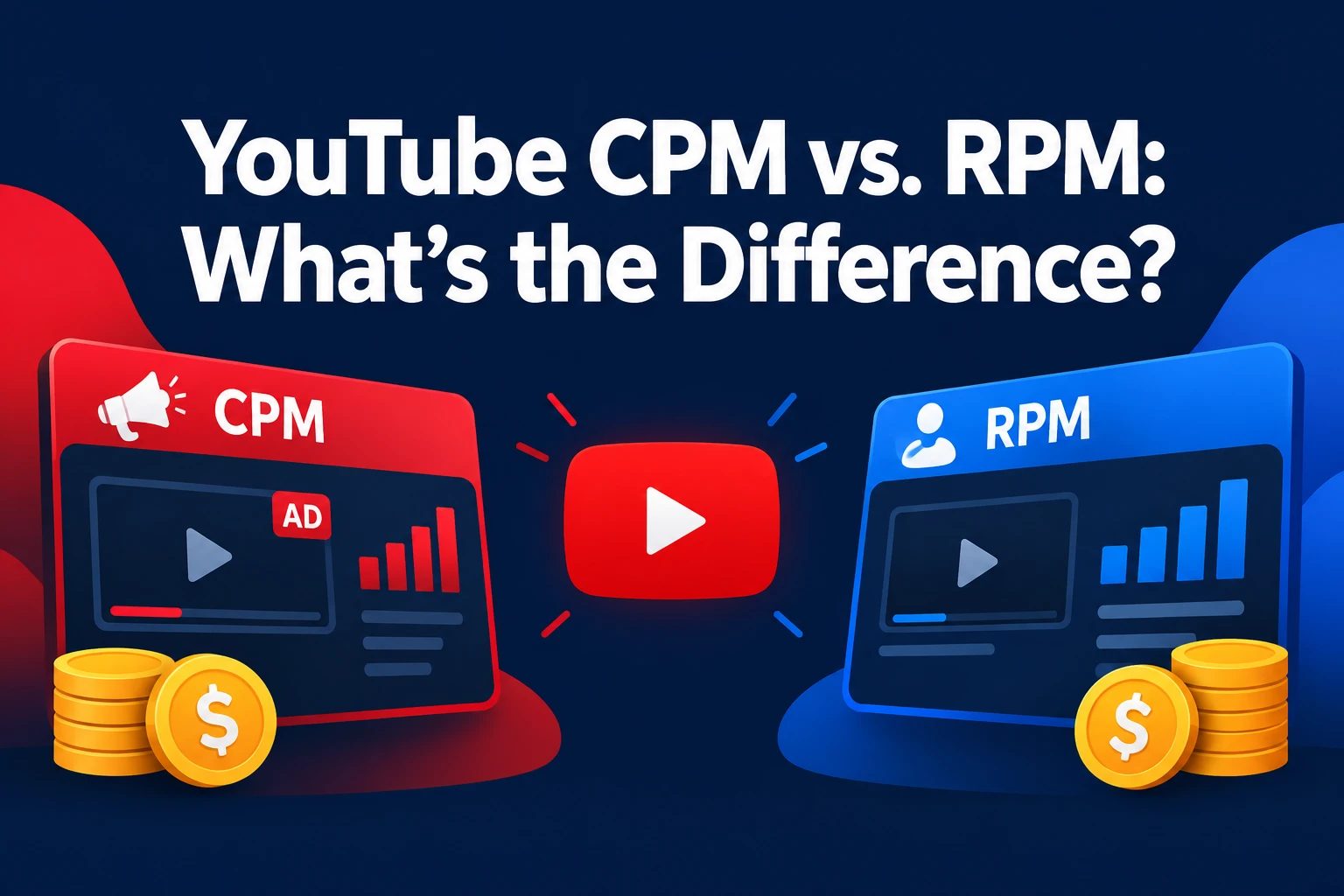
| Comparison | CPM | RPM |
|---|---|---|
| Definition | Cost per 1,000 ad impressions | Creator revenue per 1,000 views; Shorts RPM uses engaged views |
| What it measures | Advertiser spending before YouTube’s share | Revenue after YouTube’s share, including several eligible YouTube revenue sources |
| Reflects creator revenue? | No-not directly | Yes, as a revenue metric, but not profit after expenses and taxes |
| How to use it | Understand advertiser demand and compare ad-market trends | Evaluate monetization performance and model revenue using comparable data |
Simple example: Suppose advertisers spend $10 per 1,000 ad impressions, while a creator’s reported RPM is $3 per 1,000 video views. Those figures can coexist because they measure different things. Not every view shows an ad, some playbacks show multiple ads, and RPM can include revenue beyond advertising. Neither number alone tells you the creator’s profit.
Common Myths About YouTube Earnings
- “YouTube pays the same amount for every 1,000 views.” There is no universal rate; actual results vary.
- “Every view generates advertising revenue.” Many views do not show an ad, and monetization eligibility matters.
- “More subscribers automatically mean more earnings.” Subscribers can help build an audience, but they do not guarantee views, ad impressions, or purchases.
- “Shorts and long-form videos have the same RPM.” They use different monetization models and should be compared with the correct denominators.
- “CPM is creator income.” CPM measures advertiser spending; it is not the amount the creator receives per 1,000 video views.
- “A high-paying niche guarantees higher earnings.” Audience, content, format, eligibility, and advertiser demand all affect the outcome.
Frequently Asked Questions About YouTube Earnings
1. How much does YouTube pay for 1,000 views in 2027?
There is no fixed amount. At a hypothetical $3 long-form RPM, 1,000 views would represent about $3 in revenue included in RPM. Your actual figure can be different, including zero advertising revenue if the channel or content is not eligible.
2. How much does YouTube pay for 10,000 views?
At the same hypothetical $3 RPM, 10,000 long-form views would represent about $30. The result changes with the actual RPM and is not a guaranteed payment.
3. How much does YouTube pay for 100,000 views?
At a hypothetical $3 RPM, 100,000 long-form views would represent about $300. Use your own comparable Analytics data for a more useful estimate.
4. How much does YouTube pay for 1 million views?
One million long-form views at a hypothetical $3 RPM would represent about $3,000. A different audience or revenue mix can produce a substantially different result.
5. Does YouTube pay for Shorts views?
Eligible creators who accept the Shorts Monetization Module can earn a share of Shorts Feed ad revenue. Payment depends on the pooled model and eligible engaged views, not a fixed amount for every public view.
6. Which country has the highest YouTube RPM?
There is no dependable universal answer. Rates vary by topic, advertiser demand, audience, format, and time period. The best comparison is your own channel’s geography data.
7. Which YouTube niche pays the most?
There is no guaranteed winner across all channels. Finance, technology, and business may attract valuable advertising in some circumstances, but a specific video’s audience and monetization performance matter more than its category label alone.
8. Do YouTube subscribers affect earnings?
Subscribers are part of YPP eligibility and can help creators build a returning audience. They are not a direct payment metric: a subscriber count alone cannot tell you a channel’s revenue. The YouTube Channel Statistics tool provides public channel context, not private earnings.
9. Can a small YouTube channel earn money?
Yes. A small channel may qualify for certain YPP features, depending on its country and eligibility, or earn through suitable outside arrangements. YouTube advertising revenue requires the applicable ad-sharing eligibility and approval; a small audience does not guarantee either approval or income.
10. How can I check my actual YouTube RPM?
Open YouTube Studio → Analytics → Revenue and look for RPM. Choose the date range and content or format you want to review. Compare like with like: long-form RPM uses video views, while Shorts RPM uses engaged views. Revenue shown in Analytics can be estimated and may change before finalization.
Conclusion
The answer to “how much does YouTube pay for 1,000 views?” is different for every creator. RPM gives you a useful way to measure revenue, but audience location, niche, monetization eligibility, and content format all influence the result. Shorts require their own engaged-view-based analysis.
Use the YouTube Money Calculator to explore possibilities, then return to YouTube Studio to check what your own content actually earns. A carefully chosen estimate is a planning tool-not a promise.

Ahassan
CEO / Co-Founder
Hello, I'm A Hassan, the owner of YTLargeTools. I created YTLargeTools with a simple goal: to make useful online tools accessible to everyone. I believe everyday tasks should be simple, convenient and easy to complete without unnecessary complications.
Recent Posts